
Mossback Update

Dear Readers,
I’ve neglected you for over a month now. My family and I have moved to Lake Tahoe, in order to be closer to my father-in-law, and where I’ve taken a new job in urology. Urology! We carry the ocean in us, landlubber mammals though we humans are, and it matters a great deal how much water we move about with, its precise balance of salts and minerals, and if and when we release that saline fluid. We tend not to think about these things until we leak too often or too little. So while I would never have told you my passion is urology, I find the science interesting. And I will enjoy moving to a practice where I have more continuity and an ongoing relationship with patients.
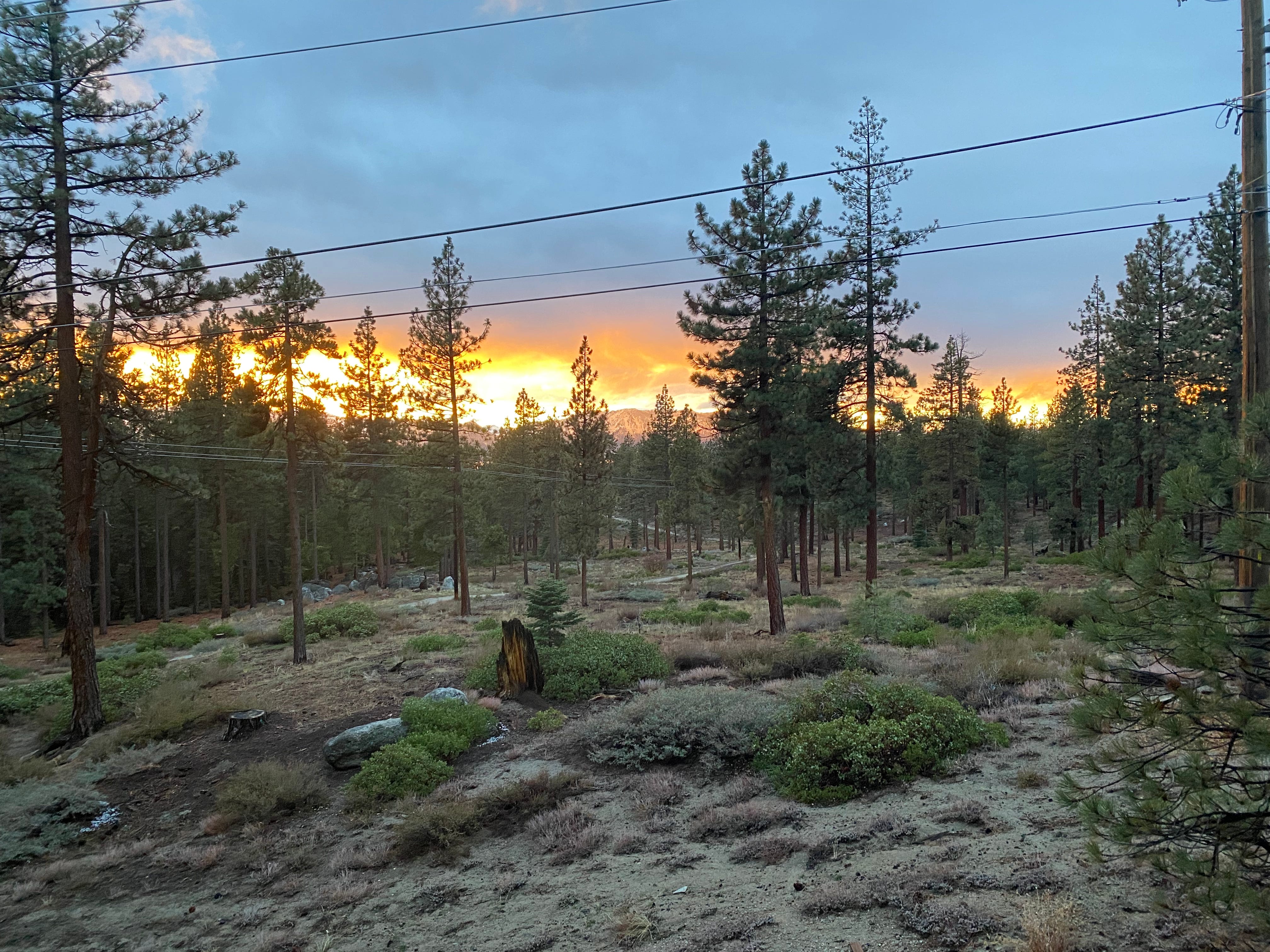
More broadly, I am more of a mountain man than an ocean man, notwithstanding the aforementioned ocean in my veins. So I am glad to be in the mountain west rather than the coast. The mountains surrounding Lake Tahoe are spectacular, and I look forward to exploring the animals, trees, and plants that call this rough and rugged terrain home.
Winters are more severe here, though thus far we’ve only had a light snow. I look forward to snow forcing a slower pace of life, and have already loved spending the cold evenings with my family in the glow of a fire. The move has made especially tender and sweet moments for our family while we inhabit a new place.
I hope to restart some of my musings on the poetics of the living world in the next month. In the meantime, here are some things I am paying attention to.
John Ganz is a writer who tracks the far right. He recently was on the Ezra Klein show and had an interesting conversation on the “groyper” movement and how Nick Fuentes is shaping, and perhaps fracturing, the political right.
Joe Davidson has a long, somewhat tedious, but fascinating account of apocalypticism in politics, and seeks to reclaim apocalyptic political theology as a liberating force.
Joseph Litke is a fellow tracker who has a lovely reflection on tracking called Finding Ourselves in the Mud.
Anna Ciaunica wrote a beautiful and fascinating treatise on how the mind is a whole body apparatus.
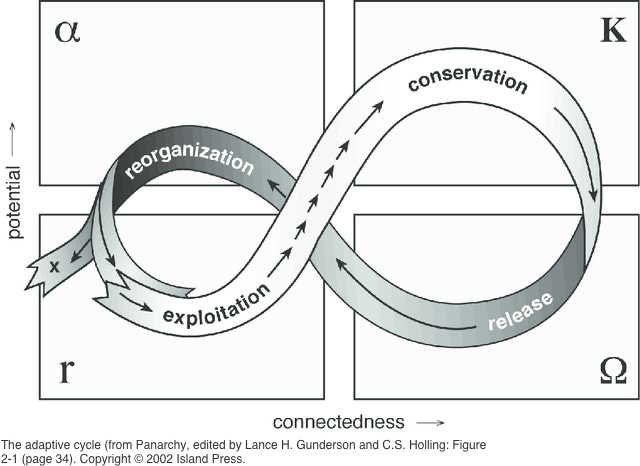
Finally, I’ll end with a poem I wrote a few years ago based on the adaptive cycle. The adaptive cycle is a systems theory framework developed by environmental scientists who sought to understood how ecological systems adapt and change over time. I love grand theories that can explain large, long processes, and this one fits the bill. What I particularly like about it is that while it was developed to understand the complex energetic dynamics of large scale ecological systems, it can also quite easily be utilized to understand one’s own internal system. Just as the a mature old growth forest emerges from a disturbed ecosystem over time, one’s own self goes through periods of disruption, emergence, maturation, and austerity.
It’s personally useful as the recent move has both disrupted our lives from being deeply connected but also time-poor, to now having much more time on our hands and in a space of temporo-social reorganization of our individual and family systems.
………………….
INSIDE OF YOU THERE IS A FOREST
Inside of you, there is a forest,
teeming with life. Old growth trees
dominate this inscape,
where crowns
reach sky and harness
billions of fleeting
photons, converting them
into sugars. This tangled wood
embodies kinship of self
with self:
lichens and mosses
adorn mantles of trees,
insects browse rich
topsoil, birds make nest,
and squirrels travel
limb to limb. This forest is
connection. Even in death, trees
become nurse logs. Mushrooms with alchemical
zeal break down fibers
into calories, and this vast
store continues to feed
the heartbeat of the forest.
Suddenly, everything changes.
Perhaps a strike
of lightning in summer storm,
or careless match.
Perhaps, unaware, you lit
all the kindling
in your heart at once.
Spark turns
to flame, flame to fire, and fire
to inferno. In hours, centuries of growth
gone. Some trees linger,
with base and limb
blackened, but bushes are
now ashes. Smoke killed those creatures
uncharred by fire. Most many-legged-insects
roast under tree bark, though some survive
in the soil.
Maybe it was
not fire, but flood.
Maybe a hurricane
made landfall in your quiet
life and dumped gallons.
Maybe spring rain fell
too hard and mixed with heavy
winter’s snow, and riverbeds
buckled and eager water rushed
across the valley,
pummeling landscape
uprooting trees
covering all
with a deep layer of silt.
Regardless, in the after
--of fire or of flood
or of burning passion
or of unyielding loss–
everything has changed.
Centuries of growth
smolder, or lie in washed-out
bundles. The ground, bared,
constricts like dry pupils
in sunlight. But just under the soil
lies a store. This moment
opens seeds
shuttered
for decades
longing
for light. The new potential
is also fragile, as one more storm
or flood will erase the stored
memory of those seeds
and wipe the fertility now
covering the ground.
Soon, soil thrums
with aliveness. Sprouts
dance about chasing the sun
with their leaves. Short-lived herbs
abound, living like rockstars,
drinking deeply of sun and nutrient. They live
hard and fast and die young,
but not before scattering seeds
with lavish abandon.
Millions of flowers woo
insects with nectar
and scent, and this partnership
of procreation and pleasure creates
possibilities for six-legged life
not present in the austere forest. Competition rules
here. Sunlight and soil fertility abound,
and the plants, insects, and animals spend
energy as quickly as they can. Biology is all
race to resources.
Your insides rupture
like buds in spring heat
and seek springs with thirsty
roots. You yield to fecund life.
Soon, lanky pines punctuate
fields of flowers. Texture and shadow
emerge. Shade provides new niches for
species to inhabit. Hardwoods that grow slow but
tolerate decades of dappled
conditions begin to emerge. Eventually, these hardwoods
dominate, casting silhouettes over the understory.
And finally, your soul has lived
centuries full circle and you no longer
fear the fire.
This is happening
inside of you,
all the time.